
Best Survival Whistle for 2025: Top 5 Picks, Real Tests & How to Choose
Why a tiny whistle still earns its place
When things go sideways, volume beats vocabulary. In a genuine emergency situation, three sharp whistle blasts cut through wind, trees, and traffic in a way shouting never will. Your voice fades fast and chews up energy; a loud whistle carries over long distances with little effort—even if you’re cold, tired, injured, or hoarse.
Phones help—until they don’t. Dead battery, no signal, wet touchscreen, or a cracked mic can all turn a cell phone into dead weight. A dedicated signal whistle is the opposite: simple, rugged, and always ready. That’s why you’ll find them bundled in emergency kits, lashed to PFDs, clipped to backpack shoulder straps, tucked into a first aid kit, or riding a key ring for everyday personal safety. It’s one of those little things that punches way above its size.
The goal of a whistle is simple: be heard—clearly and consistently. That’s where design matters. A pealess whistle has no moving parts or small ball to freeze or clog, so it keeps working in spray, sleet, and cold weather. A classic pea whistle offers a distinctive trill some people prefer for cadence and Morse code, but it can stumble in slush and salt. Materials matter too: tough polymers and metals (aluminum or titanium) resist physical damage, stand up to harsh conditions, and won’t mind being forgotten in a damp pocket after a long outdoor activity.
Context matters as well. In thick bush or urban areas, the right pitch and tone help a whistle punch through background noise so rescue teams can triangulate. On open coastline, wind and surf eat certain frequencies, so the loudest whistle on paper isn’t always the most effective in practice. That’s why, for 2025, we’re testing both spec-sheet decibel level and real-world carry to recommend the best whistles for where and how you travel.
Bottom line: a great whistle is light, durable, and brutally simple—and when you need it, you’ll be grateful it doesn’t rely on apps or antennas. In the sections ahead, we’ll explain our test method, share weighted scores, and name our Top 5 picks—so you can add the right tool to your survival kit and keep it there for the long time you’ll hopefully never need it.
How we test & score (method + weighted criteria)
To separate marketing hype from real performance, we combined spec checks with simple, repeatable field tests. The goal: measure how well a whistle can summon help in adverse conditions with little effort, and how reliably it keeps doing that for a long time.
Test setup
-
Loudness (objective): We use a decibel meter at a fixed distance in open air, then repeat in cross-wind and light rain. Because “spec dB” can be optimistic, we record both decibel level and perceived carry.
-
Tone & carry (subjective but structured): Multiple listeners stand downwind and crosswind to judge clear sound and penetration. We note whether higher frequency or lower pitch cuts better in trees, traffic, and surf-like noise (simulated with a white-noise speaker).
-
Wet & cold reliability: We dunk whistles, shake, and blow; then run a freezer test (simulated cold temperatures) to check for clogging or icing. Pealess design generally shines here; pea whistle designs can suffer when the small ball freezes.
-
Ease of use: Try with gloves and when winded—how hard is the first toot? Mouth comfort and grip matter when you’re shaking or wearing hearing protection around loud environments.
-
Durability checks: Pocket carry with keys and a pocket knife, drops to hard ground, and minor crush/torque to assess physical damage resistance. We also inspect the body of the whistle for cracks over time.
-
Packability & carry: We weigh and size every unit (looking at small size and light weight), and test attachment on PFDs, sternum shoulder straps, and key rings.
-
Value & availability (AU context): We note typical price, shipping fee, and expected business days to deliver (because availability can determine your best bet before a trip or natural disaster season).
-
Why pealess matters: A pealess whistle has no moving parts to absorb water or ice up. In harsh conditions (spray, sleet, sand), that’s often the difference between a call for help and silence. Pea units like the ACME Thunderer still have a place—some people prefer their trill for timing short blasts, long blasts, and even Morse code—but acknowledge the trade-offs.
Buyer’s Quick Guide — pick the right whistle fast
If you only skim one section, make it this one. Here’s how to match a whistle to your environment, carry style, and budget—without overthinking it.
Step 1: Choose your core type
-
Pealess whistle (recommended for most): No moving parts, so nothing to swell, crack, or freeze. Best in spray, sleet, and cold temperatures. Predictable clear sound with little effort.
Use if: You want maximum reliability in adverse conditions. -
Pea whistle: Classic trill thanks to the small ball (pea). Some folks like the cadence control for short blasts, long blasts, or improvising Morse code. Can misbehave in slush and salt.
Use if: You prioritize that familiar tone and plan to avoid freezing spray.
Step 2: Match environment to tone & loudness
-
Marine/coast & wet tropics: Wind and surf eat certain pitches. Look for models marketed as “storm” or “all-weather” (storm whistle, Fox 40 sonik blast class). They stay loud when soaked and keep working after dunking.
Why: Better wet/cold reliability, stronger perceived carry over long distances. -
Alpine/cold weather: Freezing mist can seize peas; go pealess design. Slightly lower pitch often travels farther through thin air.
Why: Ice resistance + tone that carries. -
Dense bush/rainforest: Mid-to-high pitch that cuts through foliage without being shrill. Avoid super-tiny bores if you want easier breath activation.
Why: Balanced decibel level and “pierce” equals better location by rescue teams. -
Urban areas: Competing traffic noise calls for a strong, assertive tone. Choose a reputable safety whistle with documented performance.
Why: You need audible separation from low-frequency city rumble.
Step 3: Pick materials to fit your use
-
Plastic whistles / plastic emergency whistles: Light, cheap, and immune to corrosion. High-end polymers resist UV and physical damage surprisingly well.
Best for: Emergency kits, first aid kit, kids/family members. -
Aluminum whistles: Rugged, compact; can dent if crushed hard.
Best for: Keychain EDC, general outdoor enthusiasts. -
Titanium whistles: Premium durability with featherweight feel (titanium whistles like vargo titanium emergency whistle).
Best for: Ultralight hikers who want years of use and bombproof reliability.
Step 4: Decide how you’ll carry it
-
Always-on-body: Key ring, neck lanyard (use a breakaway), or pack shoulder straps.
Tip: Don’t bury it in a pouch—seconds matter in a dire situation. -
Kitted setup: Stage a whistle in each survival kit, emergency kits, and first aid kit.
Tip: Tape a tiny instruction card: “3 blasts = help.” Include duct tape and a signal mirror in the pouch. -
Water work: Choose buoyant, high-vis body of the whistle or add a float.
Step 5: Consider ease of use & safety
-
Ease of use: Prefer a big, grippy mouthpiece and wide bore; easier to sound when winded or gloved.
-
Hearing protection: A loud whistle can be very loud up close. Angle away from your ear; brief blasts only.
-
Proper care: Rinse after salt, dry, and inspect for cracks. Replace frayed cords and scratched mouthpieces.
Quick picks by scenario
-
Maximum raw volume in wind/surf: Go “storm-class” (best emergency whistle for marine).
-
All-rounder for mixed terrain: Fox 40 Sonik Blast-type pealess whistle is your best bet.
-
Ultralight EDC/keychain: Nitecore NWS20 or Vargo Titanium Emergency Whistle (tiny, light weight, small size).
-
Classic cadence control: ACME Thunderer (pea) or ACME Tornado 2000 (pealess) depending on your freeze risk.
-
Kids & family members: Bright plastic safety whistle staged on a breakaway lanyard; practice whistle blasts at home with common sense rules.
-
Pro tip: Redundancy wins. Carry a primary pealess on your sternum strap and a micro backup on your keys. In a natural disaster, you’ll thank yourself.
Fox 40 Sonik Blast CMG (Pealess) — Top Pick
Score: 9.10/10

Source - Fox40
Why it wins: A dependable, all-weather safety whistle that’s blisteringly loud yet easy to sound with little effort. The cushioned mouth grip is comfortable with gloves, and the tone stays clear in spray. It’s the one we trust for most emergency kits and outdoor activity setups.
Specs (quick): pealess design; robust polymer body of the whistle; compact small size; very light weight; bright colors.
Best for: All-round use—bush, urban areas, paddling, day hikes; great for family members who need simple, repeatable whistle blasts.
Pros: Extremely loud; reliable in adverse conditions; comfortable mouthpiece; easy to stage on shoulder straps.
Cons: Polymer can scuff with years of use (cosmetic); not buoyant unless you add a float.
Storm Safety Whistle (Pealess) — Loudest in rough weather - Score: 9.07 / 10

Source - Stormwhisltes
Why it stands out: Often cited among the loudest whistle options, the “storm-class” design keeps blasting after dunking. Its clear sound and strong projection make it a best emergency whistle for coastal conditions and natural disaster prep.
Specs (quick): pealess; high-output chamber; polymer shell; slightly larger profile.
Best for: Marine/coastal, wet tropics, heavy wind where maximum punch is your primary concern.
Pros: Monster volume; excellent wet/cold reliability; easy activation even when winded.
Cons: Bulkier than others; not the tiniest for keychain carry; bring hearing protection awareness when practicing.
ACME Tornado 2000 (Pealess) — Projection & pedigree - Score: 8.85/10

Source - Acme Tornado
Why it stands out: The ACME Tornado lineage is famous for tone separation and projection (the company’s designs list multiple U.S. patent filings across models). The 2000 variant projects a confident, assertive call that cuts through foliage and traffic rumble in urban areas.
Specs (quick): pealess; tough polymer; compact; high visibility colors.
Best for: Mixed terrain, team outings, events where rescue teams or marshals need to locate you fast.
Pros: Strong, penetrating tone; proven brand; excellent all-round ease of use.
Cons: Not quite as weather-brute as Storm; polymer shows scuffs over time.
Nitecore NWS20 Titanium (Pealess) — Ultralight EDC punch - Score: 8.85/10
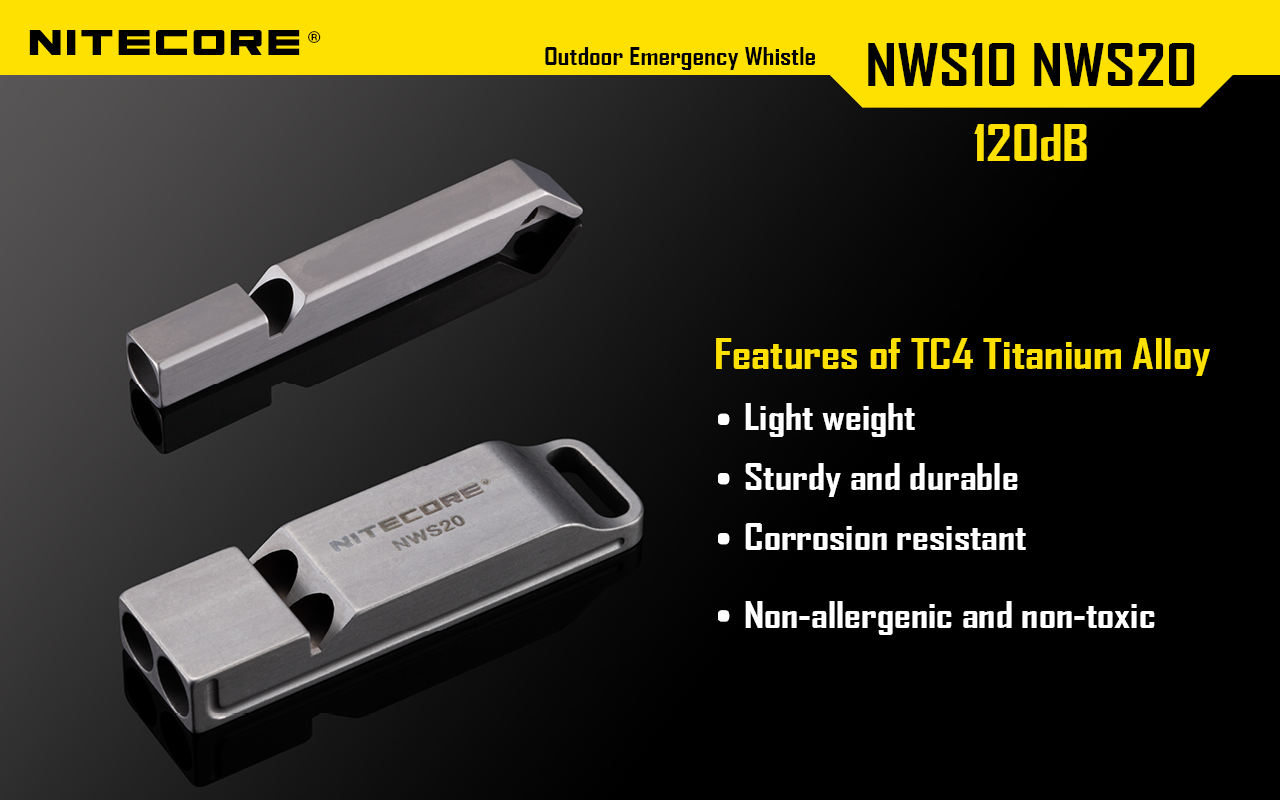
Source - Nitecore
Why it stands out: A tiny titanium whistle that vanishes on a key ring yet delivers serious output for its size. Titanium laughs off corrosion and extreme temperatures, so it’s easy to recommend for minimalist carry.
Specs (quick): pealess; titanium body; featherweight; micro form factor.
Best for: Everyday carry, backup on zipper pulls, “always-on-you” redundancy for personal safety.
Pros: Small size, light weight; years of use durability; zero maintenance beyond proper care rinses.
Cons: Not the raw-loud champion; harder to grip with thick gloves than a full-size.
Vargo Titanium Emergency Whistle (Pealess) — Bombproof backup
Score: 8.70/10
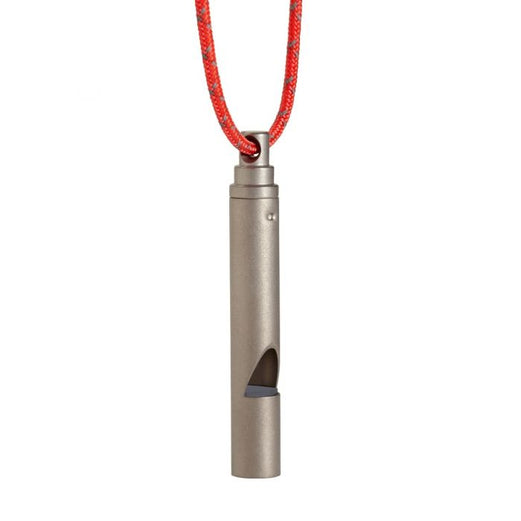
Source: Vargo
Why it stands out: The Vargo titanium emergency whistle is a minimalist’s dream: rugged, reliable, and always ready. It’s a simple whistle that shrugs off abuse and keeps performing in harsh conditions.
Specs (quick): pealess; titanium; micro-compact; keychain slot.
Best for: Ultralight hikers, off-grid travelers, anyone who wants a near-indestructible backup staged on shoulder straps or keys.
Pros: Virtually immune to corrosion; fantastic durability-to-weight; ideal for multi-year stashing in survival kit/first aid kit.
Cons: Not the loudest overall; tiny mouthpiece is less comfy with thick gloves.
Side-by-Side Comparison Table
| Model | Pea/Pealess | Material | Weight | Perceived Carry (wind/rain) | Wet/Cold Reliability | Ease of Use (gloves) | Packability | Score/10 |
|---|---|---|---|---|---|---|---|---|
| Fox 40 Sonik Blast CMG | Pealess | Polymer | Very light | Excellent, clear over long distances | Excellent | Very good (grippy mouth) | Compact; clips to shoulder straps | 9.10 |
| Storm Safety Whistle | Pealess | Polymer | Light | Outstanding in wind/surf; among loudest | Excellent | Good | Medium (a bit bulky) | 9.07 |
| ACME Tornado 2000 | Pealess | Polymer | Light | Excellent projection in urban & bush | Very good | Very good | Compact | 8.85 |
| Nitecore NWS20 Titanium | Pealess | Titanium | Ultra-light | Very good for micro form factor | Excellent | Good (tiny mouth) | Small size; vanishes on keys | 8.85 |
| Vargo Titanium Emergency Whistle | Pealess | Titanium | Ultra-light | Very good for micro form factor | Excellent | Good | Ultra-compact | 8.70 |
Which One Should You Buy? (Decision Paths)
Skip the second-guessing. Match your use case to one of these simple paths and you’ll land on the right whistle.
If your primary concern is raw volume in bad weather
-
Pick: Storm Safety Whistle
-
Why: Among the loudest whistle options and famous for staying loud after dunking. Cuts through surf, spray, and wind—ideal for marine, cyclone season, or natural disaster readiness.
-
Carry tip: Stage it on your PFD or pack shoulder straps; consider a float so it’s easier to find in chop.
If you want the best all-rounder for mixed terrain
-
Pick: Fox 40 Sonik Blast CMG
-
Why: A reliable pealess whistle with clear sound, comfort, and ease of use. It’s the best bet for most people and most trips—great in urban areas, forest, and open country.
-
Carry tip: Clip to sternum strap; stash a second unit in your emergency kits/first aid kit.
If you want maximum projection with pedigree
-
Pick: ACME Tornado 2000
-
Why: Proven design with assertive projection and crisp tone that helps rescue teams pinpoint you.
-
Carry tip: Bright color aids recovery; add reflective cordage to the lanyard.
If you want ultralight, always-on-you EDC
-
Pick: Nitecore NWS20 Titanium
-
Why: Small size, light weight, and durable titanium that handles extreme temperatures and harsh conditions for years of use.
-
Carry tip: Keychain or zipper pull. Pair with a micro signal mirror and a wrap of duct tape on a card for a tiny survival tool stack.
If you want a near-indestructible backup
-
Pick: Vargo Titanium Emergency Whistle
-
Why: Minimalist, rugged, and dependable. Not the absolute loudest, but stellar longevity.
-
Carry tip: Keep it as the “just-in-case” second whistle—the one that never leaves your kit.
If you prefer classic trill and cadence control
-
Pick: ACME Thunderer (pea whistle)
-
Why: Some folks like the trill for pacing short blasts, long blasts, or quick Morse code cues.
-
Caveat: The small ball can freeze or stick in slush; for cold temperatures, a pea-less design is safer.
Maintenance & longevity (cold, wet, and real life)
Your whistle should feel boringly reliable—year after year. A little proper care goes a long way, especially if you’re in salt, snow, or grit.
Cold, wet, and filthy: what actually matters
-
Cold temperatures & ice: Moisture inside a pea whistle can freeze the small ball. A pealess design avoids that failure mode and is the safer choice for alpine trips and shoulder-season storms.
-
Extreme temperatures: Metals handle heat swings well; titanium whistles shrug off expansion/contraction cycles. Polymers can stiffen in deep cold but high-grade plastics still perform in real weather conditions.
-
After dunking: Shake hard, blow once to clear, then do your signal. If you’re in surf or heavy rain, expect a tiny delay on the first toot—then it should fire normally.
Damage & wear: when to repair or replace
-
Physical damage: Inspect the body of the whistle for hairline cracks, bent split rings, or crushed mouthpieces after a fall. If tone changes or airflow feels restricted, retire it.
-
Cordage & clips: Replace frayed lanyards and weak key rings. Consider a small section of reflective cord to help you find it at night.
-
UV & abrasion: Plastic whistles can show scuffs after years of use; that’s cosmetic. Cracks aren’t. Swap it before a big trip.
Salt, grit, and storage
-
Saltwater: Rinse with fresh water, shake dry, and leave it where air circulates (not sealed damp in a pouch).
-
Dust & grit: A quick rinse restores a clear sound and prevents abrasive wear.
-
Long-term storage: Keep one staged on your shoulder straps and a spare in your survival kit, emergency kits, or first aid kit. Add a tiny note card: “3 blasts = help.”
Practice—briefly and smartly
-
Short sessions: It’s a loud whistle at close range. Angle away from your ear and others. Consider hearing protection during practice in enclosed spaces.
-
Signal discipline: Use three short blasts in a real emergency situation. Save experiments (like Morse code) for training days only.
-
Bottom line: rinse, inspect, and replace at the first sign of doubt. Simple habits keep a tiny tool ready for the worst day, across all seasons and terrains.
The shortlist you can trust
If you want one whistle that does almost everything well, grab the Fox 40 Sonik Blast CMG. It’s loud, dependable, and easy to blow with little effort—even when you’re cold, wet, or tired. If your primary concern is raw punch in wind and surf, the Storm Safety Whistle is the hammer. Need an everyday, disappears-on-the-keyring option? Go Nitecore NWS20 Titanium or Vargo Titanium Emergency Whistle. Want pedigree and projection in mixed terrain and urban areas? ACME Tornado 2000 is a classic for a reason.
Redundancy is still the smartest move: one primary on your sternum/shoulder straps, plus a tiny titanium backup on your keys or zipped to your jacket. Add a signal mirror, a wrap of duct tape, and a simple instruction card (“3 blasts = help”) to each first aid kit and survival kit. Small upgrades; big returns on the worst day.
FAQ'S
1: How loud is “loud enough” for a hiking or personal safety whistle?
A: Aim for high, consistent output that carries over long distances. Spec decibel level helps, but real-world penetration through wind/trees/traffic matters more. Our top picks balance both.
2: Pealess vs pea—what’s better in cold and wet?
A pealess whistle (no moving parts or small ball) keeps working after dunking and in cold temperatures. A pea whistle (e.g., ACME Thunderer) has a distinctive trill some prefer for pacing short blasts, long blasts, or Morse code, but it can freeze or clog.
3: Can a whistle damage hearing?
Up close, a loud whistle can be intense. Angle away from your ear and keep practice sessions brief; consider hearing protection in enclosed spaces.
4: What’s the best setup for kids or family members?
Bright plastic whistles on breakaway lanyards. Keep instructions simple (three whistle blasts = help), and practice once a term with common sense safety rules.
5: Do titanium or aluminum models sound different than plastic?
Not inherently. Materials influence durability (corrosion, physical damage) and weight (light weight, small size). The chamber design drives tone and volume.
6: Will a whistle work in urban noise?
Yes—choose strong projection with a pitch that cuts through traffic rumble. Our ACME and Fox 40 picks excel in urban areas.
7: Should I carry other small signaling tools?
Yes. Pair your whistle with a signal mirror for daylight, a headlamp at night, and tape/cord for improvised fixes. These little things make a real difference.
8: What maintenance keeps a whistle reliable for years of use?
A: Rinse after salt or grit, dry, inspect the body of the whistle, replace frayed cordage, and retire it if tone changes. That’s proper care.