
The Best Survival Knife Sharpeners: Field-Tested Top 5
Why a sharpener belongs in every kit
A dull knife is a time thief. It turns simple camp jobs—cutting cordage, prepping tinder, trimming a tent stake—into a slow grind. A sharp knife, on the other hand, feels effortless and safer because it bites where you want it to. If you carry EDC blades, a pocket knife, or a big knife for heavier work, the best way to keep moving is to carry a portable sharpener that actually works in the field.
What do we mean by “sharp”? It isn’t just about slicing paper once. A reliable edge comes from matching the correct angle, keeping a consistent angle along the full blade shape, and setting the edge geometry for the task. Most of the time you’ll restore a sharp edge with a few light passes and a quick tidy-up—no need to rebuild a bevel every time.
Where does a field sharpener fit? Think of sharpening as two worlds:
-
Field use: quick touch-ups when you nick the knife’s edge, hit grit, or the side of the blade starts to skid on rope. This is where compact tools shine—no water, no bench, minimal fuss.
-
Home/base: deeper work like setting a new edge on a chipped blade or polishing a mirror finish. That’s where bigger stones and tabletop-style fixed-angle systems live.
Steel matters too. Carbon steel takes an edge fast and responds well to light maintenance. Stainless steel can be a little more stubborn, but modern alloys are excellent once you pair them with the right abrasive. Either way, a small, packable tool that maintains the right angle is your best mate on the track.
A quick note on crossover: yes, some sharpeners can do kitchen knife duty in a pinch, but this guide focuses on tools that earn their keep in a pack. We’ll talk through options that suit light pocket knives, medium camp blades, and big choppers, so you’re not stuck babying a tool that wasn’t built for the job.
By the end, you’ll know which sharpener suits your kit, how it handles dull knife emergencies, and how to keep sharp knives working for a long time—without turning your weekend into a sharpening session.
How we tested (real-world, not just bench)
Sharpeners are easy to love on a desk and disappointing on a log. So we tested the lot the way you’ll actually use them: outside, dry, sometimes wet, sometimes sandy, and often when we had little time.
Knives & steels
-
Carbon steel camp knife (drop-point, 1095 equivalent) — responds quickly, shows sharpening quality clearly.
-
Stainless steel folder (AUS-8/14C28N class) — a bit tougher, good for “does it actually bite?” checks.
-
Medium camp knife with a thicker spine — reveals how a tool handles more metal.
-
Pocket knife with small bevel — tests control at a consistent angle.
-
Serrated edge section (where supported) — for ceramic/triangular rods.
Abrasives & setups
-
Diamond plates (coarse → fine) for fast repair and setting a new edge.
-
Ceramic rods for refining and deburring.
-
Leather strop (with compound) for chasing a razor edge in the field.
-
If the tool included an angle guide, we used it; otherwise, we held a correct angle by feel.
Field conditions
-
Dry use only (no water stones in the bush), including gloved handling.
-
Contamination test: quick wipe after the stone hit dust/sand to see if it still cut.
-
Wet test: light drizzle and damp hands to check grip and feedback.
-
Speed runs: 90-second touch-up (realistic trail window when you don’t have a lot of time).
What we measured
-
Bite & polish: does the edge catch thumbnail and slice clean paper? Can it make small feather sticks without skating?
-
Angle control: how easy was it to hold a consistent angle? Do built-in guides actually help?
-
Material removal: can coarse diamond fix a ding efficiently, or does it take forever?
-
Versatility: plain edges, light serrations, short vs big knife blades.
-
Portability: weight, small size, how it packs in a pocket or pouch.
-
Durability & maintenance: plate wear-in, ceramic glazing, how easily diamond cleans up.
-
Ease of use & learning curve: can a newer user get better results without stuffing the bevel?
Scoring conversion
Each tool is graded against our rubric (Performance, Versatility, Ease of use, Portability, Durability, Value). We total to 100, then convert to a score /10 so you can compare at a glance. Tools that delivered best results quickly, with solid control and minimal faff, scored higher; ones that needed a lot of time or punished small mistakes… didn’t.
Scoring rubric (so you know exactly how we rate)
A “great knife sharpener” isn’t just the one that makes one blade sharp one time. It’s the tool that gives consistent angle control, repeatable sharpening quality, and a reliable sharp edge with minimal fuss—whether you’re fixing a dull knife or just freshening a bevel. Here’s how each product is scored, weighted to 100, then converted to a single score /10.
The six criteria (with weights)
-
Sharpening performance – 30%
How quickly and cleanly the tool forms a burr, removes a lot of material when needed, and refines to a razor edge. We check bite on thumbnail, paper slice, and light feather sticks.
Signals: quality of the new edge, evenness along the knife’s blade, ability to balance bite vs polish. -
Versatility – 20%
Works across carbon steel and stainless steel, short pocket knives to big choppers, and supports serrations (where relevant). Also looks at grit range (coarse to finer grit) and accessories (e.g., leather strop, ceramic rods).
Signals: handles odd blade shape, supports touch-ups and repairs, not just one trick. -
Ease of use – 15%
How simple it is to hold the right angle. Tools with a decent angle guide or intuitive feedback score higher, especially for mixed skill level users with a normal learning curve.
Signals: set-and-go feel, clear feedback, not punishing on technique. -
Portability – 15%
Small size, weight, and packability. Can you throw it in a pouch and forget about it until needed?
Signals: true portable sharpener that stays protected (hinges, sheaths) and doesn’t rattle itself to death. -
Durability & maintenance – 10%
Plate wear, ceramic glazing, hinge sturdiness, and how easily it cleans.
Signals: long-lived diamond plate/stone, resilient ceramic rods, tidy storage (bonus if a leather sheath is included). -
Value for money – 10%
Performance and flexibility for the price. We’re weighing best performance versus what most knife owners will actually use.
Signals: good value over a long time, not just flashy features.
Top Picks Snapshot
Here’s the quick hit list before we dive deep. All five are proven in field use, keep a consistent angle with minimal faff, and balance ease of use with best performance for a sharp edge that lasts.
-
Best Overall — Work Sharp Guided Field Sharpener (GFS 221)
A compact portable sharpener with dual diamond plates, ceramic rods, an angle guide, and a leather strop. Handles carbon steel and stainless steel, from pocket knives to big choppers. Delivers a great edge fast and packs small.
Why it wins: Most complete field toolkit in one small size package; excellent value and repeatability. -
Best Pocket Stone — Fallkniven DC4 (fallkniven dc)
Two-sided sharpening stone (diamond + ceramic) that runs dry—no oil or water. Zero moving parts, rides in a pouch, and chews through hard steels.
Why it wins: Bomb-proof simplicity, excellent bite on premium blades, still refines to a clean finish with a touch of strop. -
Best Fast Fix — DMT Diafold Double-Sided (Coarse/Fine)
Full-length folding diamond stones with a simple handle. Ideal when you need to remove a lot of material to set a new edge, then tidy with a finer grit.
Why it wins: Speed and flatness; the longer stroke improves control on larger knives. -
Best Emergency Multi-Tool — Lansky Tactical Blademedic
Pocketable “do-it-now” unit: carbide & ceramic pull-through sharpeners, plus a tapered rod for serrations and hooks.
Why it wins: Gets a dull knife cutting again in little time. Not the ultimate finish, but the best “it lives in the pocket” fixer. -
Best Base-Camp Consistency — Spyderco Tri-Angle Sharpmaker
A tabletop-style fixed-angle system with triangular ceramic rods. Superb for holding the right angle on everything from small knives to odd blade shape and serrations.
Why it wins: Ultra-repeatable results and an easy learning curve; perfect when pack weight isn’t the priority.
Work Sharp Guided Field Sharpener — Best Overall
Score - 8.8/10
If you only pack one sharpener, make it this. The Work Sharp Guided Field Sharpener (GFS 221) bundles the stuff you actually use—dual diamond plates, ceramic rods (including a small fish-hook/serration option), fixed angle guide faces, and a leather strop—into a palm-sized, trail-proof block. It’s the tidy answer to “I want a sharp edge now” without lugging a kit.

Source: Work Sharp Tools
What it is (and why it works)
-
Abrasives: swappable diamond plate faces (coarse/fine) for fast repair and shaping a new edge; triangular ceramic rods for refining and for serrations; end-cap leather strop to chase a near razor edge.
-
Guides: moulded angle guide faces on the body help you lock the correct angle and keep a consistent angle from heel to tip.
-
Format: flat, grippy chassis that sits nicely on a log, rock, or your knee; genuinely portable sharpener you’ll actually carry.
Best for
-
Field use from quick touch-ups to light repairs on pocket knives, camp blades and big choppers.
-
Carbon steel and stainless steel alike, including many modern alloys.
-
“I’ve got little time” moments where a few passes restore bite.
Pros
-
Ease of use: fixed guides flatten the learning curve; great for a range of skill level.
-
Versatility: does plain edges and light serrations; works on premium blade steels better than most pocket tools.
-
All-in-one: you don’t need to juggle a separate honing rod or strop in the bush.
-
Packability: small size, rides quietly in a pouch, no faff.
Cons
-
Not a mirror-finish machine: you’ll get a working great edge, but true show-polish belongs to bench kits.
-
Angle faces are fixed: fantastic for most knives, but if you love oddball blade shape or unusual edge geometry, you may prefer a fully adjustable tabletop rig.
Specs (the useful bits)
-
Format: flat block with two diamond stones, ceramic rods, and leather strop.
-
Carry: pocket/pouch friendly; stable in hand or on a stump.
-
Maintenance: brush/erase the diamond; wipe the ceramic to prevent glazing; dress the strop occasionally.
Fallkniven DC4 — Best Pocket Stone
Score - 8.4/10
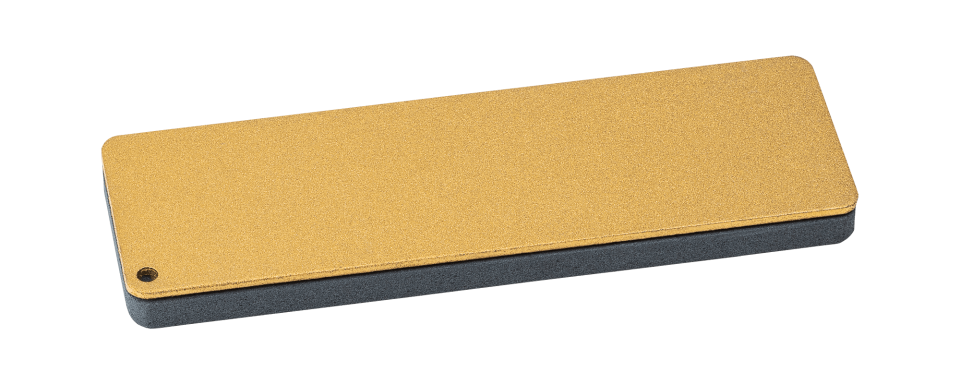
If you like simple, bomb-proof gear, the Fallkniven DC4 is your mate. It’s a two-sided sharpening stone: one diamond face for fast cutting, one ceramic face for smoothing. No water, no oil, no moving parts—just you, the blade, and a slab that rides in your pocket. For many, it becomes the favourite knife sharpener because it quietly does the job for a long time.
Source: Fallkniven
What it is (and why it works)
-
Abrasives: coarser diamond plate for bite and shaping a new edge; fine ceramic for deburring and refining to a tidy working finish.
-
Dry use: unlike water stones or oil stone routines, the DC4 runs dry—perfect for field use.
-
Form factor: flat, compact, and grippy enough to stay put on a stump or your palm; true portable sharpener.
Best for
-
Hard and premium blade steels that shrug off softer stones (think modern stainless steel and tougher carbons).
-
Small knives, EDC blades, and mid-sized camp knives where flat strokes shine.
-
Folks who want control over edge geometry without a fixed angle guide.
Pros
-
Sharpening quality: diamond cuts fast; ceramic smooths to a surprisingly fine working finish.
-
Versatility: handles carbon steel and high-end stainless steel without drama.
-
Durability: no hinges or inserts to fail; easy to clean and lasts a long time.
-
Packability: small size and flat shape disappear into a pouch.
Cons
-
Learning curve: no built-in angle guide; beginners need a touch of practice to hit the sweet spot.
-
No serration tool: unlike rod systems, serrated touch-ups aren’t its thing.
-
Not the fastest way to polish a show finish—save that for home rigs.
Specs (the useful bits)
-
Format: double-sided plate (diamond/ceramic).
-
Carry: pocket or pouch; some versions come with a leather sheath.
-
Maintenance: brush the diamond; rub the ceramic clean with an eraser or Scotch-Brite.
DMT Diafold Double-Sided — Best Fast Fix & Flatness
Score - 8.4/10

Source: Dmtsharp
Need to reset a bevel in the bush or chew through a ding quickly? The DMT Diafold Double-Sided is the pocket workhorse. Two folding diamond stones (e.g., Coarse/Fine or Fine/Extra Fine) swing out from a simple handle, giving you a longer stroke than most field tools. That length, plus DMT’s flat plates, is why it’s brilliant for setting a new edge or correcting geometry on a big knife.
What it is (and why it works)
-
Abrasives: true diamond plate surfaces that cut fast and stay flat. Coarse options pull off real repair work; finer grit faces tidy the scratch pattern.
-
Format: folding arms protect the plates in your pocket, then open to full length for stable, controlled strokes.
-
Control: no fixed angle guide, but the extra stroke length makes it easier to hold a consistent angle by feel.
Best for
-
Rapid stock removal when you’ve got a chip or rolled spot—remove a lot of material with fewer passes.
-
Medium to big knife blades and machete-ish edges that benefit from longer, flatter strokes.
-
Users comfortable freehanding, or those pairing it with a guide rod clamp (back at base) for more repeatability.
Pros
-
Speed: among the fastest manual sharpeners for real repairs and setting a new edge.
-
Flatness: keeps edge geometry honest on longer blades.
-
Durability: proven plates; easy to clean; takes on high-end steels.
-
Packability: folds small but opens long—nice balance for field use.
Cons
-
No guides: there’s a learning curve for beginners; angle control is on you.
-
Scratch pattern: coarse diamond looks aggressive until you finish on fine or strop.
-
Not ideal for serrations on its own (no ceramic rods or tapered file included).
Specs (the useful bits)
-
Format: two-sided folding diamond stones (e.g., Coarse/Fine).
-
Carry: slips into a pocket; plates protected when closed.
-
Maintenance: rinse/wipe; scrub with a plastic eraser if it loads up.
Lansky Tactical Blademedic — Best Emergency Multi-Tool
Score - 8.3/10
Source: Lansky Sharpeners
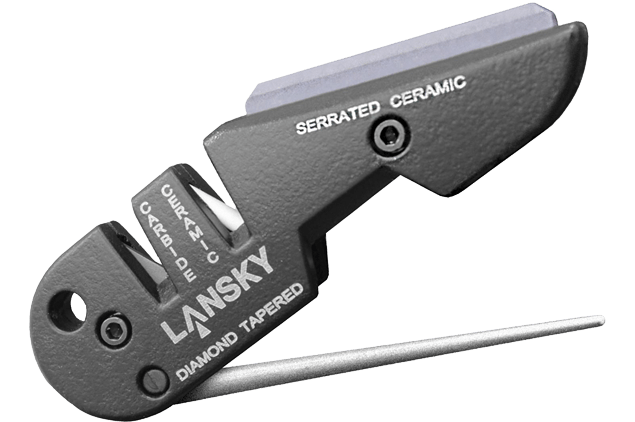
When your dull knife shows up at the worst time, the Lansky Tactical Blademedic is the “back to work in 60 seconds” tool. It stuffs a lot into a tiny body: carbide and ceramic pull-through sharpeners for quick V-slot fixes, a tapered ceramic rod for serrations and hooks, and a small ceramic bench for touch-ups. It’s not a showpiece finisher—but as an always-there fixer, it’s brilliant.
What it is (and why it works)
-
Pull-through sharpeners: coarse carbide to re-establish bite, fine ceramic to clean the edge—ideal when you’ve got little time.
-
Tapered rod: deals with serrations, gut hooks, and awkward curves that flat stones can’t reach.
-
Pocket format: solid little unit that disappears beside your pocket knife or in a pouch.
Best for
-
Emergency touch-ups on replaceable blade knives, EDC blades, and campsite utility knives.
-
Users who value ease of use over perfection—get a working edge fast, then carry on.
-
Field kits where weight and small size matter and you want a safety net for a single time quick fix.
Pros
-
Speed & simplicity: among the quickest manual sharpeners to revive a knife’s edge.
-
Versatility for its size: flat edge, basic V-bevels, and serrations covered.
-
Good value: inexpensive backup that turns a non-cutting tool into a sharp knife again.
Cons
-
Coarse slots can be aggressive: use a light touch to protect edge geometry and premium bevels.
-
Not a premium finisher: you’ll get a solid working edge, not a mirror.
-
Angle is fixed-ish: less control than stones or tabletop-style fixed-angle systems like Spyderco Sharpmaker.
Specs (the useful bits)
-
Format: compact multi-tool with carbide & ceramic V-slots and a tapered ceramic rod.
-
Carry: key pouch/pocket friendly; small size and sturdy build.
-
Maintenance: blow out grit; wipe ceramic; avoid oily contamination in the slots.
Spyderco Tri-Angle Sharpmaker — Best Base-Camp Consistency
Score - 8.4/10

Source: Spyderco
When you want repeatable results and easy angle control, the Spyderco Tri-Angle Sharpmaker is the go-to. It’s a tabletop-style fixed-angle system that uses triangular ceramic rods set at preset angles, so you keep the blade vertical and the tool takes care of the right angle. It’s superb for plain edges, odd blade shape, and especially serrations. Not pocketable, but unbeatable for confidence and consistency on trips or at home.
What it is (and why it works)
-
Preset angles + vertical strokes: you hold the knife straight up and down; the base sets the geometry. That’s why it’s so good at a consistent angle—the system removes guesswork.
-
Triangular ceramic rods: corners for serrations and tight spots; flats for quick refinement and deburring.
-
Modular: swap rod grits (medium/fine, ultra-fine) and add extras later if you want an even best edge.
Best for
-
Camp/base sharpening where pack weight isn’t the priority.
-
Plain edges, small knives, multi-tools—and any serrated blade.
-
Users who want best results without wrestling a freehand learning curve.
Pros
-
Ridiculously repeatable: among the easiest ways to maintain a consistent angle.
-
Serration star: the rod corners reach where plates can’t.
-
Scales well: from pocket knives to kitchen cross-over (kitchen knives) with excellent control.
-
Gentle on edges: removes less steel than aggressive V-slot pull-through sharpeners.
Cons
-
Not truly fieldable: it’s compact for a bench tool, but not a true portable sharpener.
-
Slower repairs: if you need to remove a lot of material (chips, new bevel), diamond plates are faster.
-
Upfront practice: still a touch of technique to keep strokes straight—less than freehand, but not zero.
Specs (the useful bits)
-
Format: bench/base kit with two triangular ceramic rods (usually medium/fine) in a folding case/stand.
-
Carry: rucksacks or glove boxes, yes; trouser pocket, no.
-
Maintenance: scrub rods with cleaner/eraser to prevent glazing; store dry.
Buyer’s guide — pick by scenario
Not sure which way to go? Match the tool to your blade, steel, and how you use it. Here’s the simple path to the best results with the right sharpener.
If you carry EDC blades and pocket knives
-
Best option: Work Sharp Guided Field Sharpener or Fallkniven DC4.
-
Why: both are true portable sharpeners with a small footprint and quick setup. Work Sharp adds an angle guide, ceramic rods, and leather strop for a faster, cleaner finish.
-
Tip: aim for the correct angle every time—light pressure, short strokes. Finish on the strop for a tidy razor edge.
If you need a new edge fast on bigger knives or choppers
-
Best option: DMT Diafold (Coarse/Fine).
-
Why: flat diamond plate eats a lot of material quickly, keeps edge geometry honest, and the longer stroke helps maintain a consistent angle on a big knife.
-
Tip: stop as soon as the burr forms, then move to finer grit; a quick strop makes it pop.
If you want the easiest angle control at base camp or home
-
Best option: Spyderco Tri-Angle Sharpmaker.
-
Why: tabletop-style fixed-angle system with preset angles = repeatable sharpening quality and less learning curve. Superb for serrations and odd blade shape.
-
Also consider: high-end bench rigs like Edge Pro or Wicked Edge for premium tuning (less portable, more precise).
If you just need emergencies covered in very little time
-
Best option: Lansky Tactical Blademedic.
-
Why: V-slot pull-through sharpeners get a dull knife working again fast; tapered rod tidies serrations.
-
Tip: use a gentle touch in the coarse slot to protect your bevel—then ceramic, then strop if available.
If you use premium blade steels (modern stainless, carbon super-steels)
-
Best option: Diamond stones are your friend (Work Sharp plates, DC4 diamond face, DMT Diafold).
-
Why: diamonds cut abrasion-resistant steels efficiently where softer stones struggle.
-
Tip: don’t chase a mirror in the field; aim for a toothy sharp edge that bites cordage.
If you sharpen kitchen knives too
-
Best option: Spyderco Sharpmaker for routine touch-ups; it carries over nicely to kitchen knives.
-
Why: fixed angles give a consistent angle; ceramics are kind to thin chef blades.
-
Also consider: a simple honing rod for day-to-day maintenance between full sharpenings.
If you’re brand new and want the simplest path
-
Best option: Work Sharp Guided Field Sharpener.
-
Why: the angle guide removes guesswork and the leather strop cleans up your work; excellent balance of ease of use and best performance for most knife owners.
-
Tip: practise on a beater blade for a single time session to learn the sweet spot.
If you like traditional stones
-
Best option: Fallkniven DC4 (dry diamond/ceramic).
-
Why: gives you classic stone control without water stones or oil stone mess in the bush.
-
Tip: keep your stroke length even and check the whole knife’s edge from heel to tip.
If you maintain replaceable blade knives
-
Best option: Lansky Blademedic.
-
Why: fast V-slot touch-ups, compact, good value as a permanent pocket backup.
Bottom line: pick the format that matches your reality—fast fixes (Blademedic), flat and fast repairs (Diafold), guided all-rounder (Work Sharp), pocket stone purity (DC4), or base consistency (Sharpmaker). That’s the best way to a reliable sharp edge without wasting a lot of time.
Care, maintenance & safety
Treat your sharpening kit like any other tool and it’ll serve you for a long time. A little routine keeps sharpening quality high and stops small problems becoming big ones.
Keep abrasives cutting well
-
Diamond plate care: after use, wipe clean; if it loads up, scrub with a plastic eraser or Scotch-Brite and a drop of dish soap. Rinse, dry, and you’re done.
-
Ceramic rods: they glaze with metal. Clean with a powder cleanser or an eraser until the surface turns light again; that restores bite.
-
Pull-through sharpeners: blow out metal dust, wipe the V-slots, and don’t oil them—oil traps grit and chews bevels.
Prevent rust and grit damage
-
Blades: after sharpening, wipe the knife’s edge and spine to remove swarf. A tiny film of light oil helps carbon steel resist rust; stainless steel still benefits from a dry wipe.
-
Storage: keep stones dry. If your pocket stone came with a leather sheath, let it air after rain—leather holds moisture.
-
Field grit: if your plate hits sand, stop and clean it. Rubbing grit into a plate dulls diamonds and scratches the bevel.
Don’t oversharpen
-
Quick touch-ups often beat full regrinds. If the blade still bites cordage, skip the coarse face and go straight to fine or ceramic, then leather strop. You’ll remove less steel and keep your edge geometry healthy.
Pressure and angle discipline
-
Use light pressure. Let the abrasive do the work.
-
Track your correct angle through the whole blade shape; angle drift is the #1 reason edges feel fine in one spot and meh in another.
When (and how) to use bench gear
-
Honing rod (at home): a few gentle passes keep edges lively between stone sessions—especially on kitchen knives.
-
Electric sharpeners: handy for home if you know the preset angles, but they remove metal fast. Not ideal for bush kits and can be harsh on thin bevels.
-
Tabletop-style fixed-angle systems: brilliant for consistent finishes and premium tuning; save big repairs or show-level polish for these.
Safety basics (because fingers > bandages)
-
Stable platform: stump, knee, or bench—no wobble.
-
Always draw the knife blade away from your support hand.
-
Pocket tools: keep fingertips clear of V-slots on pull-through sharpeners.
-
Pack sharp: cap the ceramic rods, fold plates, and sheath blades before they go back in the pouch.
Signs it’s time to refresh or replace
-
Diamond plate feels slick even after cleaning → diamonds may be worn.
-
Ceramic rods stay dark and feel glassy → deep clean or replace.
-
Hinges or cases that rattle → tighten or tape so grit doesn’t work in.
Bottom line: clean abrasives, light pressure, smart storage, and quick touch-ups are the best way to keep a dependable, sharp edge without burning a lot of time—and without chewing through your knives.
Conclusion — the best choice for most people
If you want one tool that covers the most ground with the least fuss, the Work Sharp Guided Field Sharpener is the best choice. It’s compact, practical, and brings the key pieces—diamond plates, ceramic rods, an angle guide, and a leather strop—into one tidy block. For most knife owners, that balance of ease of use, portability, and sharpening quality delivers the best performance in real field use.
Prefer a simple slab with no moving parts? The Fallkniven DC4 is the flat-stone classic: small, tough, and effective on carbon steel and stainless steel, especially premium blade steels. If you’re resetting a new edge or removing a lot of material on a big knife, the DMT Diafold is the fast, flat cutter that keeps edge geometry honest. Need a tiny safety net that lives in the pocket? Lansky Tactical Blademedic is the “get it cutting again” multi-tool for dull knives when you’ve got little time. And if you want repeatable angles for base-camp touch-ups (and kitchen knives at home), the Spyderco Tri-Angle Sharpmaker is a tabletop-style fixed-angle system that makes holding a consistent angle feel natural.
Whichever way you go, the best way to a dependable sharp edge is a light, regular touch-up before things go fully blunt. Keep your strokes steady, your pressure light, and your angles consistent. Finish with a quick strop, and you’ll enjoy a great edge for a long time without burning a day on the stones.
Frequently asked questions
1) What’s the best way to sharpen a knife in the field if I’ve only got a minute?
Use a pocket tool like the Lansky Tactical Blademedic. Do 2–4 light passes in the ceramic V-slot, then a few on the tapered rod if you’ve got serrations. If you carry a leather strop, finish with 10 trailing passes. That’s the fastest route to a working sharp edge with little time.
2) Diamond plate, ceramic rods, or water stones—what’s better outside?
For field use, diamond + ceramic wins. Diamond stones cut fast and handle premium blade steels; ceramic rods refine and deburr cleanly. Water stones shine at home but are messy and fragile on the track.
3) Do pull-through sharpeners damage knives?
Used gently, they’re fine for quick fixes on a dull knife. Heavy pressure in coarse pull-through sharpeners can thin the bevel and change edge geometry. Keep passes light; follow with fine ceramic and a leather strop.
4) How do I find the correct angle without a guide?
Raise the spine until it looks like a matchbook gap—then lock your wrist. Keep that consistent angle heel to tip. If you’d rather not guess, the Work Sharp Guided Field Sharpener has a built-in angle guide.
5) Can I sharpen serrations in the field?
Yes—use a tapered ceramic rod (Blademedic) or the corners of triangular rods (Spyderco Sharpmaker). Match each scallop’s bevel with 2–4 light strokes, then one gentle pass on the flat side to clear the burr.
6) My steel is stainless and pretty hard. Will these kits work?
Yep. Diamond plate tools (Work Sharp plates, Fallkniven DC4, DMT Diafold) handle abrasion-resistant stainless steel and modern high-end alloys well. Finish on ceramic and strop for a tidy bite.
7) Are electric sharpeners a good idea?
For home kitchen knives, sure—if the preset angles suit your blades. For bush kits, they’re heavy, need power, and can remove a lot of material quickly. A compact manual system is the better option outdoors.
8) What about big choppers and machetes?
Go long and flat. The DMT Diafold gives you a longer stroke to keep edge geometry straight on a big knife. Set the new edge on coarse, refine with finer grit, strop, done.
9) I want set-and-forget angles at home—what should I buy?
The Spyderco Tri-Angle Sharpmaker is the easy win for a tabletop-style fixed-angle system. If you’re chasing ultra-precise bevels and don’t mind bench time, consider Edge Pro or Wicked Edge—super consistent, less portable.
10) Do I really need a honing rod as well?
Not in the field, but at home a honing rod is a great way to realign an edge between stone sessions—especially on kitchen knives. It saves steel and keeps you sharper for longer.